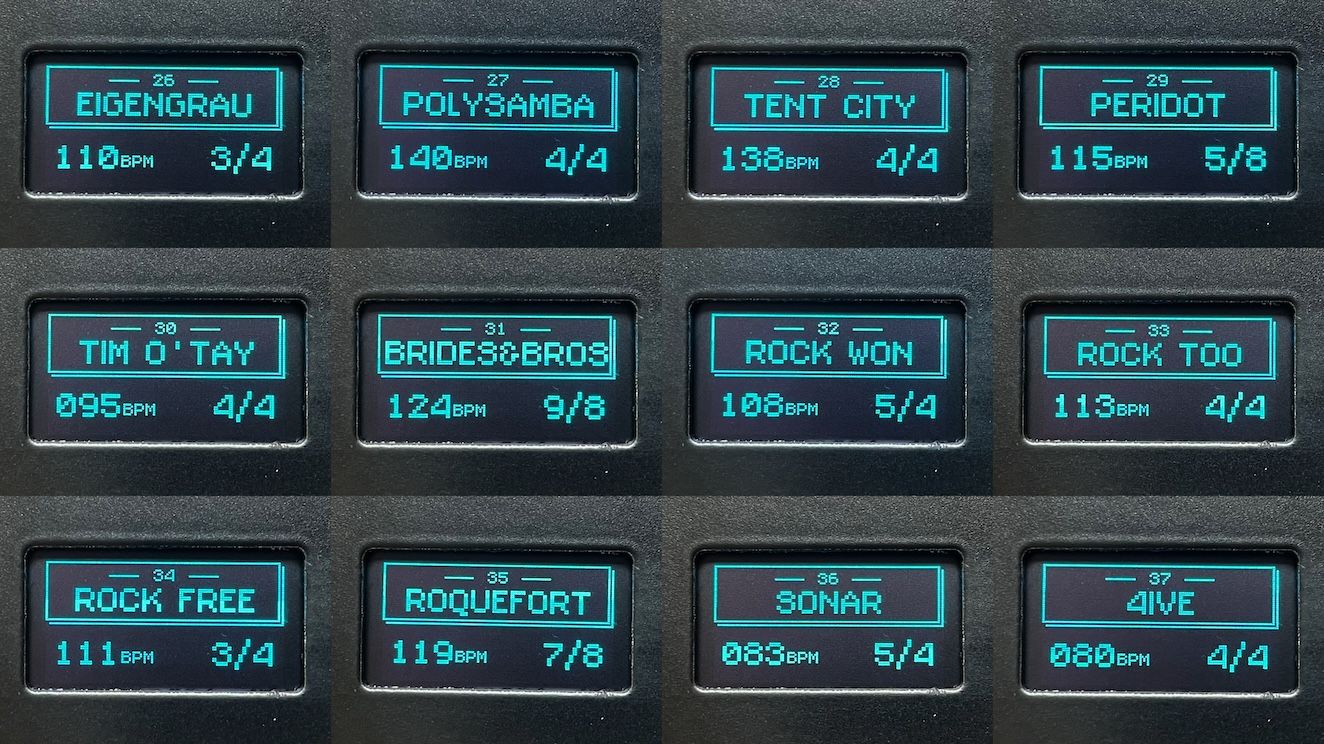
The Beat Friend is a generative analogue drum machine by audio.computer — and it's one of those rare instruments you can just play.
No menu diving, no preset anxiety. Six sliders, a few knobs, and suddenly you're in a conversation with a machine that has genuine opinions about rhythm. Turn up the complexity and it starts filling in ideas you didn't know you wanted. Back it off and it locks into something solid and honest. The Enthusiasm knob alone is worth the price of admission.
We decoded the .bff patch format to visualize the
structure of every stock pattern — the generative DNA
that the Beat Friend uses to keep surprising you. Each dot below
is an event waiting to fire, its size and color hinting at when and
how it enters the mix.
Reading the visualizations
Each row is one of the six drum voices. Each dot is a single event stored in the patch file — a potential hit that the generative engine may or may not play depending on the position of the complexity slider for that drum. Dots are positioned left to right across time, and vertical lines mark where pattern variations begin.
When you switch to By Weight coloring, dots are
shaded on a scale from dim to bright. This represents the raw
param byte — a single value (0–190) stored
alongside every event in the .bff file. We don't yet
know exactly what it controls, but analysis of 22,667 events across
all 37 patches reveals a clear distribution: low values appear
consistently in every patch while high values are sparse and
concentrated in the more complex patterns. Our working theory is
that it encodes a complexity threshold — the
slider position at which the event becomes active:
- foundation
- Always present. The skeleton of the beat.
- core
- Fills in at low complexity. Basic groove elements.
- groove
- Mid complexity. The pattern starts to breathe.
- texture
- High complexity. Syncopation and ghost notes appear.
- fill
- Very high complexity. Busy, detailed passages.
- flourish
- Maximum complexity. Rare ornamental hits.
These labels are our invention, not official terminology. They’re derived from statistical analysis of the patch data and an educated guess about the generative engine’s behavior. The true meaning of the param byte — and whether it really is a complexity threshold, a velocity, a probability, or something else — awaits confirmation from the device itself.
37 patches · 22,667 events · 6 analogue voices